Advertisement

Monday, January 18, 2016

University of Cambridge

University of Cambridge 

The University of Cambridge is a university open exploration college in Cambridge, England. Established in 1209, Cambridge is the second most established college in the English-talking world and the world's fourth-most seasoned surviving university. It became out of a relationship of researchers who left the University of Oxford after a debate with the townspeople. The two antiquated colleges offer numerous regular elements and are frequently mutually alluded to as "Oxbridge". 

Cambridge is framed from an assortment of establishments which incorporate 31 constituent universities and more than 100 scholastic divisions sorted out into six schools. The college involves structures all through the city, a hefty portion of which are of authentic significance. The schools are self-administering foundations established as indispensable parts of the college. In the year finished 31 July 2015, the college had an aggregate salary of £1.638 billion, of which £397 million was from exploration stipends and contracts. The focal college and schools have a joined blessing of around £5.89 billion, the biggest of any college outside the United States. Cambridge is an individual from numerous affiliations and shapes part of the "brilliant triangle" of driving English colleges and Cambridge University Health Partners, a scholastic wellbeing science focus. The college is firmly connected with the advancement of the innovative business bunch known as "Silicon Fen". 

Cambridge has numerous outstanding graduated class, including a few prominent mathematicians, researchers, financial experts, scholars, savants, performing artists, lawmakers. Ninety-two Nobel laureates have been partnered with it as understudies, personnel, staff or alumni. Throughout its history, the college has highlighted in writing and creative works by various writers including Geoffrey Chaucer, E. M. Forster and C. P. Snow.

History 
By the late twelfth century, the Cambridge district as of now had an insightful and clerical notoriety, because of ministers from the close-by parish church of Ely. Be that as it may, it was an occurrence at Oxford which is well on the way to have shaped the foundation of the college: two Oxford researchers were hanged by the town powers for the demise of a lady, without counseling the clerical powers, who might ordinarily come first (and pardon the researchers) in such a case, however were around then in struggle with the King John. The University of Oxford went into suspension in challenge, and most researchers moved to urban communities, for example, Paris, Reading, and Cambridge. After the University of Oxford improved quite a long while, sufficiently later researchers stayed in Cambridge to frame the core of the new college. So as to claim priority, it is regular for Cambridge to follow its establishing to the 1231 contract from King Henry III giving it the privilege to teach its own particular individuals and an exception from a few expenses. 

A bull in 1233 from Pope Gregory IX gave moves on from Cambridge the privilege to educate "all over in Christendom". After Cambridge was portrayed as a studium generale in a letter by Pope Nicholas IV in 1290, and affirmed in that capacity in a bull by Pope John XXII in 1318, it got to be normal for specialists from other European medieval colleges to visit Cambridge to think about or to give address courses.

Establishment of the schools 
The schools at the University of Cambridge were initially an accidental element of the framework. No school is as old as the college itself. The universities were enriched associations of researchers. There were likewise organizations without gifts, called lodgings. The lodgings were continuously consumed by the schools throughout the hundreds of years, however they have abandoned a few markers of their time, for example, the name of Garret Hostel Lane.

Current period 
After the Cambridge University Act formalized the hierarchical structure of the college, the investigation of numerous new subjects was presented, for example, religious philosophy, history and cutting edge dialects. Assets essential for new courses in expressions of the human experience, structural engineering and paleohistory were liberally given by Richard Fitzwilliam of Trinity College. Somewhere around 1896 and 1902, Downing College sold a portion of its property to fabricate the Downing Site, including new experimental research facilities for life systems, hereditary qualities and Earth sciences. Amid the same period, the New Museums Site was raised, including the Cavendish Laboratory, which has subsequent to moved toward the West Cambridge Site, and different divisions for science and solution. 

The University of Cambridge started to recompense doctorates in the first third of the twentieth century. The main Cambridge PhD in science was granted in 1924.eyssonsu Maurice.

Educating 
The scholarly year is separated into three scholastic terms, controlled by the Statutes of the University. Michaelmas term keeps going from October to December; Lent term from January to March; and Easter term from April to June. 

Inside of these terms undergrad educating happens inside of eight-week periods called Full Terms. By University statutes, it is a prerequisite that amid this period all understudies ought to live inside of 3 miles of the Church of St Mary the Great; this is characterized as Keeping term. Understudies can graduate just on the off chance that they satisfy this condition for nine terms (three years) while acquiring a Bachelor of Arts or twelve terms (four years) when concentrating on for a Master of Science, Engineering or Mathematics. 

These terms are shorter than those of numerous other British colleges. Students are additionally anticipated that would plan vigorously in the three occasions (known as the Christmas, Easter and Long Vacations).
Share:

Friday, January 15, 2016

Massachusetts Institute of Technology

Massachusetts Institute of Technology

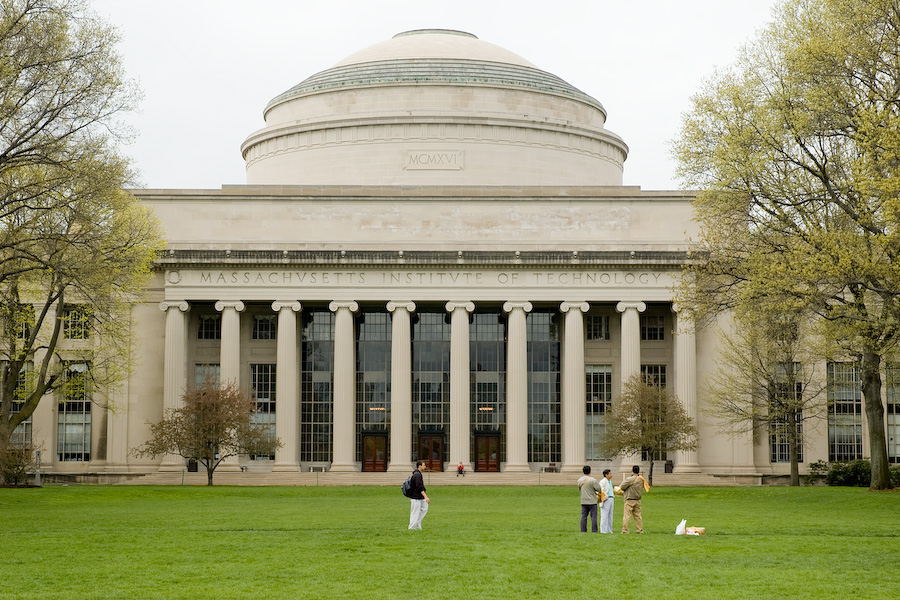
 The Massachusetts Institute of Technology (MIT) is a private exploration college in Cambridge, Massachusetts. Established in 1861 in light of the expanding industrialization of the United States, MIT embraced an European polytechnic college show and focused on lab guideline in connected science and building. Scientists chipped away at PCs, radar, and inertial direction amid World War II and the Cold War. Post-war safeguard research added to the fast extension of the staff and grounds under James Killian. The ebb and flow 168-section of land (68.0 ha) grounds opened in 1916 and reaches out more than 1 mile (1.6 km) along the northern bank of the Charles River bowl. 

MIT, with five schools and one school which contain an aggregate of 32 divisions, is regularly refered to as among the world's top universities. The Institute is generally known for its examination and instruction in the physical sciences and designing, and all the more as of late in science, financial aspects, phonetics, and administration too. The "Designers" support 31 sports, most groups of which contend in the NCAA Division III's New England Women's and Men's Athletic Conference; the Division I paddling programs contend as a feature of the EARC and EAWRC. 

Starting 2015, 85 Nobel laureates, 52 National Medal of Science beneficiaries, 65 Marshall Scholars, 45 Rhodes Scholars, 38 MacArthur Fellows, 34 space travelers, and 2 Fields Medalists have been subsidiary with MIT. The school has a solid entrepreneurial society, and the accumulated incomes of organizations established by MIT graduated class would rank as the eleventh-biggest economy on the planet. 

Two days after the sanction was issued, the first skirmish of the Civil War broke out. After a long postpone through the war years, MIT's first classes were held in the Mercantile Building in Boston in 1865. The new foundation had a mission that coordinated the aim of the 1862 Morrill Land-Grant Colleges Act to store organizations "to advance the liberal and down to earth training of the mechanical classes", and was an area award school. In 1866, the returns from area deals went toward new structures in the Back Bay.

MIT was casually called "Boston Tech". The organization received the European polytechnic college display and underlined research facility guideline from an early date. Despite interminable money related issues, the establishment saw development in the most recent two many years of the nineteenth century under President Francis Amasa Walker. Programs in electrical, concoction, marine, and sterile designing were introduced, new structures were assembled, and the extent of the understudy body expanded to more than one thousand.

The educational programs floated to a professional accentuation, with less concentrate on hypothetical science. The youngster school
still experienced ceaseless money related deficiencies which redirected the consideration of the MIT administration. Amid these "Boston Tech" years, MIT workforce and graduated class rebuked Harvard University president (and previous MIT staff) Charles W. Eliot's rehashed endeavors to union MIT with Harvard College's Lawrence Scientific School.There would be no less than six endeavors to retain MIT into Harvard. In its cramped Back Bay area, MIT couldn't bear to extend its packed offices, driving an edgy quest for another grounds and subsidizing. Inevitably the MIT Corporation endorsed a formal consent to converge with Harvard, over the eager protests of MIT workforce, understudies, and alumni. However, a 1917 choice by the Massachusetts Supreme Judicial Court successfully put a conclusion to the merger scheme.

Plaque in Building 6 respecting George Eastman, author of Eastman Kodak, who was uncovered as the unknown "Mr. Smith" who kept up MIT's autonomy 

In 1916, the MIT organization and the MIT sanction crossed the Charles River on the stylized freight boat Bucentaur fabricated for
the occasion, to connote MIT's turn to an extensive new grounds to a great extent comprising of filled arrive on a mile-long tract along the Cambridge side of the Charles River. The neoclassical "New Technology" grounds was planned by William W. Bosworth and had been subsidized to a great extent by unknown gifts from a puzzling "Mr. Smith," beginning in 1912. In January 1920, the contributor was uncovered to be the industrialist George Eastman of Rochester, New York, who had created systems for film generation and preparing, and established Eastman Kodak. Somewhere around 1912 and 1920, Eastman gave $20 million ($236.2 million in 2015 dollars) in real money and Kodak stock to MIT.

Curricular reforms 

In the 1930s, President Karl Taylor Compton and Vice-President (successfully Provost) Vannevar Bush accentuated the significance of unadulterated sciences such as material science and science and lessened the professional practice required in shops and drafting studios. The Compton changes "reestablished trust in the capacity of the Institute to create initiative in science and in addition in engineering." Unlike Ivy League schools, MIT cooked more to working class families, and depended more on educational cost than on blessings or gifts for its funding. The school was chosen to the Association of American Universities in 1934.

Still, as late as 1949, the Lewis Committee mourned in its report on the condition of training at MIT that "the Institute is generally imagined as fundamentally a professional school", a "mostly unjustified" discernment the council looked to change. The report thoroughly inspected the undergrad educational programs, prescribed offering a more extensive instruction, and cautioned against letting building and government-supported exploration take away from the sciences and humanities. The School of Humanities, Arts, and Social Sciences and the MIT Sloan School of Management were framed in 1950 to contend with the effective Schools of Science and Engineering. Already minimized resources in the regions of financial matters, administration, political science, and semantics rose into strong and confident offices by drawing in regarded teachers and propelling aggressive graduate programs.The School of Humanities, Arts, and Social Sciences kept on creating under the progressive terms of the all the more humanistically arranged presidents Howard W. Johnson and Jerome Wiesner somewhere around 1966 and 1980.

Resistance research

MIT's inclusion in military exploration surged amid World War II. In 1941, Vannevar Bush was named leader of the government Office of Scientific Research and Development and guided subsidizing to just a select gathering of colleges, including MIT. Engineers and researchers from the nation over accumulated at MIT's Radiation Laboratory, built up in 1940 to help the British military in creating microwave radar. The work done there fundamentally influenced both the war and resulting research in the area. Other barrier ventures included spinner based and other complex control frameworks for gunsight, bombsight, and inertial route under Charles Stark Draper's Instrumentation Laboratory; the advancement of a computerized PC for flight recreations under Project Whirlwind; and rapid and high-height photography under Harold Edgerton. By the end of the war, MIT turned into the country's biggest wartime R&D contractual worker (pulling in some feedback of Bush), utilizing almost 4000 in the Radiation Laboratory alone and getting in overabundance of $100 million ($1.2 billion in 2015 dollars) before 1946. Work on guard ventures proceeded even after then. Post-war government-supported exploration at MIT included SAGE and direction frameworks for ballistic rockets and Project Apollo. 

" ...a uncommon kind of instructive organization which can be characterized as a college enraptured around science, building, and expressions of the human experience. We may call it a college constrained in its goals however boundless in the expansiveness and the exhaustiveness with which it seeks after these objectives.

— MIT president James Rhyne Killian, 1949

These exercises influenced MIT significantly. A 1949 report noticed the absence of "any extraordinary loosening in the pace of life at the Institute" to coordinate the arrival to peacetime, recalling the "scholastic serenity of the prewar years", however recognizing the critical commitments of military examination to the expanded accentuation on graduate training and fast development of staff and facilities. The personnel multiplied and the graduate understudy body quintupled amid the terms of Karl Taylor Compton, president of MIT somewhere around 1930 and 1948; James Rhyne Killian, president from 1948 to 1957; and Julius Adams Stratton, chancellor from 1952 to 1957, whose foundation building methodologies molded the extending college. By the 1950s, MIT no more just profited the commercial enterprises with which it had labored for three decades, and it had grown closer working associations with new supporters, generous establishments and the elected government. 

In late 1960s and mid 1970s, understudy and personnel activists dissented against the Vietnam War and MIT's protection research. The Union of Concerned Scientists was established on March 4, 1969 amid a meeting of employees and understudies looking to move the accentuation on military examination toward ecological and social problems. MIT at last stripped itself from the Instrumentation Laboratory and moved all characterized research off-grounds to the Lincoln Laboratory office in 1973 because of the protests. The understudy body, staff, and organization remained nearly unpolarized amid what was a tumultuous time for some other universities. Johnson was seen to be profoundly effective in driving his foundation to "more prominent quality and solidarity" after these seasons of turmoil.

Share:

Sunday, January 10, 2016

Stanford University

Stanford University

Stanford University, formally Leland Stanford Junior University, is a private examination college in Stanford, California, and one of the world's most prestigious institutions, with the top position in various rankings and measures in the United States. 

Stanford was established in 1885 by Leland Stanford, previous Governor of and U.S. Congressperson from California and driving railroad investor, and his wife, Jane Lathrop Stanford, in memory of their just kid, Leland Stanford, Jr., who had passed on of typhoid fever at age 15 the earlier year. Stanford conceded its first understudies on October 1, 1891 as a coeducational and non-denominational establishment. Educational cost was free until 1920. The college battled fiscally after Leland Stanford's 1893 demise and again after a significant part of the grounds was harmed by the 1906 San Francisco earthquake. Following World War II, Provost Frederick Terman upheld personnel and graduates' entrepreneurialism to manufacture independent nearby industry in what might later be known as Silicon Valley. By 1970, Stanford was home to a straight quickening agent, and was one of the first four ARPANET hubs (forerunner to the Internet).

The principle grounds is in northern Santa Clara Valley neighboring Palo Alto and between San Jose and San Francisco. Stanford additionally has land and offices elsewhere. Its 8,180-section of land (3,310 ha) grounds is one of the biggest in the United States. The college is likewise one of the top gathering pledges establishments in the nation, turning into the first school to raise more than a billion dollars in a year.


Stanford's scholarly quality is wide with 40 divisions in the three scholastic schools that have college understudies and

another four expert schools. Understudies contend in 36 varsity sports, and the college is one of two private establishments in the Division I FBS Pac-12 Conference. It has increased 108 NCAA group championships, the second-most for a college, 476 individual titles, the most in Division I, and has won the NACDA Directors' Cup, perceiving the college with the best general athletic group accomplishment, consistently since 1994-1995.


Causes and early years (1885–1906) 

The college formally opened on October 1, 1891 to 555 understudies. On the college's opening day, Founding President David Starr Jordan (1851–1931) said to Stanford's Pioneer Class: "[Stanford] is holy by no conventions; it is hampered by none. Its finger posts all point forward." However, greatly went before the opening and proceeded for quite a while until the passing of the last Founder, Jane Stanford, in 1905 and the demolition of the 1906 tremor. 

Establishment 


Stanford was established by Leland Stanford, a railroad tycoon, U.S. congressperson, and previous California senator, together with his wife, Jane Lathrop Stanford. It is named to
pay tribute to their just youngster, Leland Stanford, Jr., who kicked the bucket in 1884 from typhoid fever just before his sixteenth birthday. His guardians chose to devote a college to their just child, and Leland Stanford told his wife, "The offspring of California might be our children." The Stanfords went by Harvard's leader, Charles Eliot, and asked whether he ought to build up a college, specialized school or exhibition hall. Eliot answered that he ought to establish a college and an enrichment of $5 million would suffice (in 1884 dollars; about $132 million today.)

High tech

A capable feeling of provincial solidarity went with the ascent of Silicon Valley. From the 1890s, the college's pioneers saw its central goal as administration toward the West and molded the school likewise. In the meantime, the apparent misuse of the West on account of eastern hobbies filled sponsor like endeavors to assemble independent indigenous nearby industry. In this manner, regionalism adjusted Stanford's hobbies to those of the territory's innovative firms for the initial fifty years of Silicon Valley's advancement. The unmistakable territorial ethos of the West amid the first 50% of the twentieth century is an element of Silicon Valley's as of now arranged environment, a fixing that would-be replicators overlook at their peril.

Amid the 1940s and 1950s, Frederick Terman, as senior member of building and later as executive, urged workforce and graduates to begin their own organizations. He is credited with sustaining Hewlett-Packard, Varian Associates, and other cutting edge firms, until what might get to be Silicon Valley grew up around the Stanford grounds. Terman is regularly called "the father of Silicon Valley." Terman empowered William B. Shockley, co-creator of the transistor, to come back to the place where he grew up of Palo Alto. In 1956 he built up the Shockley Semiconductor Laboratory. Unhappy workers from Shockley's organization shaped Fairchild Semiconductor and different organizations in the end spun off from Fairchild.
Share:

Tuesday, January 5, 2016

Harvard University

Harvard University


Harvard University is a private Ivy League research college in Cambridge, Massachusetts, set up 1636, whose history, impact and riches have made it a standout amongst the most prestigious colleges in the world.

Built up initially by the Massachusetts assembly and before long named for John Harvard (its first supporter), Harvard is the United States' most established foundation of higher learning, and the Harvard Corporation (formally, the President and Fellows of Harvard College) is its initially sanctioned partnership. Albeit never formally subsidiary with any category, the early College principally prepared Congregationalist and Unitarian church. Its educational programs and understudy body were steadily secularized amid the eighteenth century, and by the nineteenth century Harvard had risen as the focal social foundation among Boston elites. Following the American Civil War, President Charles W. Eliot's long residency (1869–1909) changed the school and subsidiary expert schools into a current exploration college; Harvard was an establishing individual from the Association of American Universities in 1900. James Bryant Conant drove the college through the Great Depression and World War II and started to change the educational programs and change confirmations after the war. The undergrad school got to be coeducational after its 1977 merger with Radcliffe College. 


The University is composed into eleven separate scholarly units—ten resources and the Radcliffe Institute for Advanced Study—with grounds all through the Boston metropolitan area: its
209-section of land (85 ha) primary grounds is focused on Harvard Yard in Cambridge, roughly 3 miles (5 km) northwest of Boston; the business college and sports offices, including Harvard Stadium, are situated over the Charles River in the Allston neighborhood of Boston and the medicinal, dental, and general wellbeing schools are in the Longwood Medical Area. Harvard has the biggest money related gift of any scholastic organization on the planet, remaining at $36.4 billion.

Harvard is an expansive, profoundly private exploration university.The ostensible expense of participation is high, yet the University's huge enrichment permits it to offer liberal monetary guide packages.It works a few expressions, social, and investigative galleries, close by the Harvard Library, which is the world's biggest scholarly and private library framework, containing 79 singular libraries with more than 18 million volumes. Harvard's graduated class incorporate eight U.S. presidents, a few outside heads of state, 62 living very rich people, 335 Rhodes Scholars, and 242 Marshall Scholars.To date, somewhere in the range of 150 Nobel laureates and 5 Fields Medalists (when recompensed) have been subsidiary as understudies, workforce, or staff.

Harvard's 209-section of land (85 ha) primary grounds is focused on Harvard Yard in Cambridge, around 3 miles (5 km west-northwest of the State House in downtown, 
House in downtown Boston, and stretches out into the encompassing Harvard Square neighborhood. Harvard Yard itself contains the focal managerial workplaces and primary libraries of the college, scholastic structures including Sever Hall and University Hall, Memorial Church, and most of the green bean residences. Sophomore, junior, and senior students live in twelve private Houses, nine of which are south of Harvard Yard along or close to the Charles River. The other three are situated in a private neighborhood a large portion of a mile northwest of the Yard at the Quadrangle (generally alluded to as the Quad), which once housed Radcliffe College understudies until Radcliffe blended its private framework with Harvard. Each private house contains spaces for students, House experts, and occupant guides, and additionally a feasting corridor and library. The offices were made conceivable by a blessing from Yale University former student Edward Harkness.

Radcliffe Yard, once the focal point of the grounds of Radcliffe College (and now home of the Radcliffe Institute), is neighboring the Graduate School of Education and the Cambridge Common.

Harvard is a huge, exceptionally private exploration university.The college has been licensed by the New England Association of Schools and Colleges since 1929. The college offers 46 undergrad focuses (majors), 134 graduate degrees, and 32 proficient degree For the 2008–2009 scholastic year, Harvard conceded 1,664 baccalaureate degrees, 400 graduate degrees, 512 doctoral degrees, and 4,460 expert degrees.

The four-year, full-time undergrad program involves a minority of enlistments at the college and stresses guideline with an "expressions and sciences focus". Between 1978 and 2008, entering understudies were required to finish a main subjects of seven classes outside of their concentration. Since 2008, college understudies have been required to finish courses in eight General Education classifications: Esthetic and Interpretive Understanding, Culture and Belief, Empirical and Mathematical Reasoning, Ethical Reasoning, Science of Living Systems, Science of the Physical Universe, Societies of the World, and United States in the World. Harvard offers an exhaustive doctoral graduate project and there is an abnormal state of conjunction in the middle of graduate and undergrad degrees. The Carnegie Foundation for the Advancement of Teaching, The New York Times, and a few understudies have condemned Harvard for its dependence on showing colleagues for a few parts of undergrad instruction; they consider this to antagonistically influence the nature of training.
Share:

University of Toronto

University of Toronto


The University of Toronto (U of T, UToronto, or Toronto) is an open examination college in Toronto, Ontario, Canada, arranged in light of the fact that encompass Queen's Park. It was established by imperial contract in 1827 as King's College, the first foundation of higher learning in the settlement of Upper Canada. Initially controlled by the Church of England, the college accepted the present name in 1850 after turning into a mainstream foundation. As a university college, it contains twelve schools, which contrast in character and history, each holding significant independence on monetary and institutional issues. It has two satellite grounds situated in Scarborough and Mississauga. 

Scholastically, the University of Toronto is noted for persuasive developments and educational module in artistic feedback and correspondence hypothesis, referred to all in all as the Toronto School. The college was the origination of insulin and undifferentiated organism inquire about, and was the site of the first down to earth electron magnifying instrument, the advancement of multi-touch innovation, the recognizable proof of Cygnus X-1 as a dark opening, and the hypothesis of NP-fulfillment. By a critical edge, it gets the most yearly experimental examination subsidizing of any Canadian college. It is one of two individuals from the Association of American Universities situated outside the United States. 

The Varsity Blues are the athletic groups speaking to the college in intercollegiate alliance matches, with especially long and storied binds to field football and ice hockey. The college's Hart House is an early illustration of the North American understudy focus, all the while serving social, scholarly and recreational hobbies inside of its expansive Gothic-restoration complex. 


The University of Toronto has instructed two Governors General of Canada and four Prime Ministers of Canada, four outside pioneers, fourteen Justices of the Supreme Court, and has been associated with ten Nobel laureates.


The establishing of a pioneer school had long been the craving of John Graves Simcoe, the first Lieutenant-Governor of Upper Canada. As an Oxford-instructed military leader who had battled in the American Revolutionary War, Simcoe trusted a school was expected to counter the spread of republicanism from the United States.The Upper Canada Executive Committee suggested in 1798 that a school be set up in York, the pilgrim capital. 


In March 15, 1827, an illustrious contract was formally issued by King George IV, declaring "from this time one College, with the style and benefits of a University ... for the training of youth in the standards of the Christian Religion, and for their direction in the different branches of Science and Literature ... to proceed for ever, to be called King's College." The giving of the sanction was to a great extent the aftereffect of exceptional campaigning by John Strachan, the compelling Anglican Bishop of Toronto who took office as the first president of the school. The first three-story Greek Revival school building was built on the present site of Queen's Park. 

Under Strachan's stewardship, King's College was a religious establishment that firmly adjusted to the Church of England and the British frontier world class, known as the Family Compact. Reformist government officials restricted the
church's control over pilgrim organizations and battled to have the school secularized. In 1849, after a long and warmed civil argument, the recently chose dependable admini-stration of Upper Canada voted to rename King's College as the University of Toronto and separated the school's ties with the congregation. Having expected this choice, the angered Strachan had surrendered a year before to open Trinity College as a private Anglican theological school. College was made as the nondenominational showing branch of the University of Toronto. Amid the American Civil War, the danger of Union barricade on British North America incited the production of the University Rifle Corps, which saw fight in opposing the Fenian strikes on the Niagara outskirt in 1866.

The University Ranking by Academic Performance puts the University of Toronto second on the planet in examination
performance. The Times Higher Education World University Rankings of 2015 positions the University of Toronto at nineteenth place all inclusive and first in Canada, while the QS World University Rankings of 2015 set the college at 34th on the planet and second in Canada.[91] In the Academic Ranking of World Universities of 2014, the University of Toronto is put at 24th on the planet and first in Canada. It positioned 25th worldwide in the 2012 report gathered by Human Resources and Labor Review on graduate performance, ninth worldwide in the 2010 Performance Ranking of Scientific Papers for World Universities,fourteenth in the High Impact Universities ranking, fourteenth in a New York Times business overview in 2013, and second comprehensively in the University Ranking by Academic Performance of 2014-2015. In 2011, the college got an evaluation of A-for ecological supportability from the Sustainable Endowments Institute.[98] The college has put first among Canada's exploration colleges in the yearly positioning by Research Infosource since 2001.[99] In 2011, the University of Toronto was named by Newsweek as one of the main three schools outside of the United States.[100] In 2014, it was likewise positioned fourteenth on the planet by the U.S. News and World Report's Best Global Universities Ranking.

The University of Toronto positioned as the country's top restorative doctoral (classification) college in Maclean's magazine for eleven back to back years somewhere around 1994 and 2004. Since 2009, it has joined 22 other national foundations in withholding information from the magazine, refering to proceeded with concerns in regards to methodology. In 2013, the Faculty of Law was named the top graduate school in Canada by Maclean's for the seventh successive year.

Share:

Wednesday, December 30, 2015

Hope College

Hope College


Trust College is a private, private aesthetic sciences school in downtown Holland, Michigan, United States, a couple of miles from Lake Michigan. It opened in 1851 as the Pioneer School by Dutch migrants four years after the group was initially settled. The main first year recruit school class registered in 1862 and Hope got its state contract in 1866. Trust College is subsidiary with the Reformed Church in America and it holds an energetic Christian air. The school's 125 sections of land (0.195 sq mi) grounds is nearby the downtown business region and has been imparted to Western Theological Seminary since 1884. The school's enlistment is a little more than 3,400 students.

Trust's proverb is taken from Psalm 42:5: "Spera in Deo" ("Hope in God"). The school's insignia is a stay. This is drawn from a discourse made by Albertus van Raalte, the pioneer of the group, on the event of the establishing of the Pioneer School in 1851: "This is my grapple of trust in this individuals later
on," (a mention to Hebrews 6:19). The essential level Pioneer School was later extended to optional, and before long, school level training as Hope College. Van Vleck Hall, which initially housed the Pioneer School, is the most established expanding on grounds (1858) and now serves as a residence. It is the second most seasoned building in the city. The primary green bean school class registered in 1862, and Hope got its state sanction in 1866. The school conceded its first female understudies in 1878. 

2015 imprints Hope College's 150th year of instruction. To pay tribute to this festival, Hope College held numerous occasions all through 2015. The festival started with the 150th beginning on May 3, 2015. The year held two thousand openings, the Kruizenga Art Museum and the Jack H. Mill operator Center for Musical Arts, and the weighty service of the Jim and Martie Bultman Student Center. The College additionally supported the Presidential Colloquium address arrangement which highlighted a location by David Brooks on Christian instruction in the 21st century.

The school offers 90+ majors, all of which prompt a Bachelor of
Arts, Bachelor of Music, Bachelor of Science, Bachelor of Science in Engineering, or Bachelor of Science in Nursing degree. It has an understudy populace of around 3,400 with an understudy to-staff proportion of 12:1. The school offers off-grounds study programs in a few US urban communities, including Philadelphia, Washington, D.C., and Chicago, and abroad projects for the late spring, semester, or a whole scholastic year. Among its worldwide projects, a long-standing summer semester in Vienna is genuinely well known among understudies. 

Trust keeps up solid binds to the Reformed Church of America and tries to instruct understudies inside of the memorable Christian confidence while keeping up a thorough scholastic training. 

What's more, Hope College is an individual from the Great Lakes Colleges Association. 

Courses offered at Hope are separated into five controls. 

General Education 
While taking courses in General Education at Hope, understudies will experience a various exhibit of points established in the human sciences training. Notwithstanding his or her real, understudies will take courses in the regions of workmanship, history, dialect, writing, math and sciences notwithstanding these courses, understudies will likewise take an interest in a First-Year Seminar course amid their first year and a Senior Seminar course in their senior year of school. These courses were created to move understudies all through their school profession. 

Expressions and Humanities 
The Fine and Performing Arts degree at Hope College comprises of four offices, which incorporate Art and Art History, Dance, Music and Theater. The Humanities division incorporates the bureaus of English, History, Modern and Classical Language, Philosophy and Religion. The Arts division at Hope College looks to "instruct each understudy and the group in the transformational force of expressions of the human experience." Hope College was the first private, aesthetic sciences school to hold national accreditation in workmanship, move, music and theater.

Regular and Applied Sciences 
The Natural and Applied Sciences programs at Hope College incorporate Biology, Biochemistry and Molecular Biology, Chemistry, Computer Science, Engineering, Geological and Environmental Sciences, Mathematics, Neuroscience, Nursing and Physics. Large portions of these offices offer exploration positions for understudies in the mid year furthermore give summer camps to rudimentary to secondary school understudies to go to. 

Sociologies 
A Social Science degree at Hope College comprises of the bureaus of Communication, Economics and Business, Education, Kinesiology, Peace and Justice minor, Political Science, Psychology and Sociology/Social Work. 

Pre-wellbeing Programs 
There are a wide assortment of pre-wellbeing programs offered by Hope at the undergrad level. These projects incorporate Chiropractic Medicine, Dentistry, GEnetic Counseling, Medicine, Occupational Therapy, Optometry, Pharmacy, Physician Assistant, Physical Therapy, Podiatry, Public Health, Speech Language Pathology and Veterinary Medicine. Other pre-wellbeing callings incorporate Nursing, Athletic Training and Pre-clinical Psychology.

Trust College contends in the MIAA gathering, and is a Division III individual from the NCAA. It at present fields 20
men's and ladies' varsity groups. The school has built a few new outside athletic venues as of late—DeVos Fieldhouse (2005), Boeve Baseball Stadium (2008), Wolters Softball Stadium (2008), Van Andel Soccer Stadium (2009) and Heeringa-Vande Poel Tennis Stadium (2012). The school as of late gained Holland Municipal Stadium from the City of Holland and has renamed it the Ray and Sue Smith to pay tribute to a long-lasting mentor and his wife. In 2006, the ladies' ball group won the National Championship in its division, the second in school history. 


Trust has won the MIAA All-Sports/Commissioner's Cup Championship more than some other part school. Trust has won the honor an alliance driving 34 times. In 2012-13 Hope competitors and/or groups fit the bill for nine NCAA titles. 

The school's athletic groups are known as the Flying Dutchmen (men) and the Flying Dutch (women).The school hues are blue and orange (conceivably picked on the grounds that the Dutch imperial family is the House of Orange-Nassau). The school supports club ice hockey and rugby notwithstanding a prevalent intramural games program.
Share:

Friday, December 25, 2015

University of Minnesota

University of Minnesota

The University of Minnesota Twin Cities (Minnesota; privately known as the U of M or basically the U) is an open examination college situated in Minneapolis and St. Paul, Minnesota. The Minneapolis and St. Paul grounds are around 3 miles (4.8 km) separated, and the Saint Paul grounds is really in neighboring Falcon Heights. It is the most seasoned and biggest grounds inside of the University of Minnesota framework and has the 6th biggest principle grounds understudy body in the United States, with 51,853 understudies in 2012–2013. The college is composed into 19 universities and schools, and it has sister grounds in Crookston, Duluth, Morris, and Rochester. 

Minnesota's athletic groups at the Twin Cities grounds are known as the Minnesota Golden Gophers and contend in the NCAA's Division I as individuals from the Big Ten Conference.


Minneapolis campus


The first Minneapolis grounds disregarded the Saint Anthony Falls on the Mississippi River, yet it was later moved around a mile (1.6 km) downstream to its flow area. The first site is currently stamped by a little stop known as Chute Square at the crossing point of University and Central Avenues. The school close down after a money related emergency amid the American Civil War, yet revived in 1867 with impressive budgetary assistance from John S. Pillsbury. It was redesigned from a private academy to a school in 1869. Today, the University's Minneapolis grounds is isolated by the Mississippi River into an East and West Bank. 


The grounds now has structures on both stream banks. The "East Bank", the primary bit of the grounds, covers 307
sections of land (124 ha). The West Bank is home to the University of Minnesota Law School, the Humphrey School of Public Affairs, the Carlson School of Management, different sociology structures, and the performing expressions focus. The St. Paul grounds is home to the College of Biological Sciences (CBS), the College of Design (CDes), the College of Food, Agriculture and Natural Resource Sciences (CFANS), and the veterinary project.

To simplicity route of the extensive grounds, the University has partitioned the East Bank into a few ranges: the Knoll territory, the Mall region, the Health region, the Athletic region, and the Gateway zone.

The Knoll zone, the most established a portion of the University's present area, is situated in the northwestern piece of the campus.[7] Most trains around there identify with the humanities. Burton Hall is home to the College of Education and Human Development. Numerous structures here are well more than 100 years of age; a 13-building bunch includes the Old Campus Historic District that is on the U.S. National Register of Historic Places.[8] A living arrangement corridor, Sanford Hall, and an understudy flat complex, Roy Wilkins Hall, are situated here. The Institute for Advanced Study[9] is situated in the Nolte Center. This range is found only south of the Dinkytown neighborhood and business territory.

Northrop Mall, or the Mall region, is seemingly the focal point
of the Minneapolis grounds. It depended on a configuration by Cass Gilbert, despite the fact that his arrangements were excessively luxurious, making it impossible to be completely implemented.[10] Several of the grounds' essential structures encompass the Mall region. The Cyrus Northrop Memorial Auditorium gives a northern grapple, with Coffman Memorial Union (CMU) toward the south. Four of the bigger structures to the sides of it are the essential arithmetic, material science, and science structures, (Vincent Hall, Tate Laboratory and Smith Hall, separately) and Walter Library. The Mall range is home to both the College of Liberal Arts, which is Minnesota's biggest open or private school, and the College of Science and Engineering. Behind CMU is another living arrangement corridor, Comstock Hall, and another understudy flat complex, Yudof Hall.

The Health region is toward the southeast of the Mall zone and concentrates on undergrad structures for natural science understudies, and homes to the College of Pharmacy, the School of Nursing, the School of Dentistry, the Medical School, the School of Public Health, and Fairview Hospitals and Clinics. This complex of structures what is known as the University of Minnesota Medical Center. A portion of the College of Biological Sciences is housed around there.

Over the road from Fairview Hospital is a zone known as the "Superblock". The Superblock is a four-city-square space lodging four home lobbies (Pioneer, Frontier, Centennial and Territorial Halls). The Superblock is a standout amongst the most prevalent areas for on-grounds lodging on the grounds that it has the biggest grouping of understudies living on grounds and has a huge number of social exercises between the home lobbies.

The Athletic zone is straightforwardly north of the Superblock and incorporates four amusement/athletic offices: the University Recreation Center, Cooke Hall, the University Fieldhouse, and the University Aquatic Center. These offices are all associated by passages and skyways permitting understudies to utilize one locker-room office. North of this complex is the TCF Bank Stadium, Williams Arena, Mariucci Arena, Ridder Arena, and the Baseline Tennis Center.

Minneapolis was named the most secure metropolitan territory in the United States by Forbes in October 2009. Notwithstanding this refinement, shootings have happened close and on campus.

Since wellbeing and security are one of the University of Minnesota's top needs, there are numerous assets at the U that offer understudies some assistance with creating a more secure environment, for example, The Step Up crusade. The Step Up battle is a project that offers understudies some assistance with doing the proper thing and forestall violations, rape, and exorbitant drinking by showing understudies how to mediate and avoid in a positive way. They do this by clarifying the Bystander impact. The U of M likewise has a TXT-U crisis notice content informing framework that conveys a warning to all workforce, staff, and understudies in the event of emergency. Similarly, there are distinctive assets which understudies can get help while returning home. 624-WALK, an escort to stroll to nearby grounds and neighborhoods, and Gopher Chauffeur, a van administration that offers rides close and on grounds. Both of these are free and open to all understudies, staff, and faculty.

What's more, there are right around 200 AED's on grounds and 200 yellow telephones for crisis just calls. The University Police Station has 20 Code Blue Phones around grounds that instantly unite individuals to their office. There are likewise more than 2,000 security cameras being checked 24 hours a day.
Share:

Thursday, December 17, 2015

University of North Carolina at Chapel Hill

University of North Carolina at Chapel Hill


The University of North Carolina at Chapel Hill, otherwise called UNC, or essentially Carolina, is a coeducational open examination college situated in Chapel Hill, North Carolina, United States. Subsequent to being sanctioned in 1789, the college first started enlisting understudies in 1795, which additionally permits it to be one of three schools to guarantee the title of the most established state funded college in the United States. North Carolina is one of the first eight Public Ivy schools that are asserted to give an Ivy League experience to an open educating price. 

The main open establishment of advanced education in North Carolina, the school opened its ways to understudies on February 12, 1795. The college offers degrees in more than 70 courses of study through fourteen universities and the College of Arts and Sciences. All students get an aesthetic sciences instruction and have the alternative to seek after a noteworthy inside of the expert schools of the college or inside of the College of Arts and Sciences from the time they acquire junior status. 

Under the administration of President Kemp Plummer Battle, in 1877 North Carolina got to be coeducational and started the procedure of integration in 1951 when African-American graduate understudies were conceded under Chancellor Robert Burton House. In 1952, North Carolina opened its own particular doctor's facility, UNC Health Care, for examination and treatment, and has subsequent to spent significant time in malignancy care. The school's understudies, graduated class, and games groups are known as "Tar Heels". 

The grounds of North Carolina is situated in Chapel Hill, North Carolina, a college town. The grounds covers a somewhat little 729 sections of land (3 km2) over Chapel Hill's downtown region, enveloping spots like the Morehead Planetarium and the numerous stores and shops situated on Franklin Street. Understudies can take an interest in more than 550 authoritatively perceived understudy associations. 

The understudy run daily paper The Daily Tar Heel has won national recompenses for university media, while the
understudy radio station WXYC gave the world's first web radio telecast. North Carolina is one of the sanction individuals from the Atlantic Coast Conference, which was established on June 14, 1953. Contending physically as the Tar Heels, North Carolina has made extraordinary progress in games, most strikingly in men's ball, ladies' soccer, and ladies' field hockey.

Sanctioned by the North Carolina General Assembly on December 11, 1789, the college's foundation was laid on October 12, 1793, close to the vestiges of a house of prayer, picked due to its focal area inside of the state.[18] The first state funded college contracted under the US Constitution, The University of North Carolina at Chapel Hill is the most established state funded college in the United States and the main such organization to give degrees in the eighteenth century. 

Amid the Civil War, North Carolina Governor David Lowry Swain convinced Confederate President Jefferson Davis to excluded a few understudies from the draft, so the college was one of only a handful few in the Confederacy that figured out how to stay open. However, Chapel Hill endured the loss of a greater amount of its populace amid the war than any town in the South, and when understudy numbers did not recoup, the college was compelled to close amid Reconstruction from December 1, 1870 until September 6, 1875. 

Regardless of beginning distrust from college President Frank Porter Graham, on March 27, 1931, enactment was gone to
bunch the University of North Carolina with the State College of Agriculture and Engineering and Woman's College of the University of North Carolina to shape the Consolidated University of North Carolina. In 1963, the merged college was made completely coeducational, albeit most ladies still went to Woman's College for their initial two years, exchanging to Chapel Hill as youngsters, since rookies were required to live on grounds and there was one and only ladies' quarters. Accordingly, Woman's College was renamed the "College of North Carolina at Greensboro", and the University of North Carolina turned into the "College of North Carolina at Chapel Hill." In 1955, UNC Chapel Hill authoritatively integrated its undergrad divisions. 

A statue of a trooper with three individuals strolling around the base. 

Confederate trooper Silent Sam, University of North Carolina at Chapel Hill by artist John Wilson. 

Amid World War II, UNC Chapel Hill was one of 131 schools and colleges broadly that partook in the V-12 Navy College Training Program which offered understudies a way to a Navy commission.

Amid the 1960s, the grounds was the area of critical political challenge. Preceding the section of the Civil Rights Act of 1964, dissents about nearby racial isolation which started unobtrusively in Franklin Street eateries prompted mass showings and disturbance. The atmosphere of common agitation incited the 1963 Speaker Ban Law forbidding addresses by communists on state grounds in North Carolina. The law was quickly censured by college Chancellor William Brantley Aycock and college President William Friday, yet was not evaluated by the North Carolina General Assembly until 1965. Small revisions to permit "rare" visits neglected to assuage the understudy body, particularly when the college's leading body of trustees overruled new Chancellor Paul Frederick Sharp's choice to permit talking welcomes to Marxist speaker Herbert Aptheker and common freedoms extremist Frank Wilkinson; be that as it may, the two speakers came to Chapel Hill at any rate. Wilkinson talked off grounds, while more than 1,500 understudies saw Aptheker's discourse over a low grounds divider at the edge of grounds, initiated "Dan Moore's Wall" by The Daily Tar Heel for Governor Dan K. Moore. A gathering of UNC Chapel Hill understudies, drove by Student Body President Paul Dickson, documented a claim in U.S. government court, and on February 20, 1968, the Speaker Ban Law was struck down. In 1969, grounds sustenance specialists of Lenoir Hall went on strike dissenting saw racial shameful acts that affected their work, earning the backing of understudy gatherings and individuals from the University and Chapel Hill group. 

From the late 1990s and forward, UNC Chapel Hill extended quickly with a 15% expansion altogether understudy populace to more than 28,000 by 2007. This was joined by the development of new offices, supported partially by the "Carolina First" gathering pledges crusade and a gift that expanded fourfold to more than $2 billion in only ten years. Professor Oliver Smithies was recompensed the Nobel Prize in Medicine in 2007 for his work in genetics.Additionally, Aziz Sancar was granted the Nobel Prize in Chemistry in 2015 for his work in comprehension the atomic repair instruments of DNA.
Share:

University of Wisconsin–Madison

University of Wisconsin–Madison


The University of Wisconsin–Madison (otherwise called University of Wisconsin, Wisconsin, "UW", or territorially as, UW–Madison, or basically Madison) is an open exploration college situated in Madison, Wisconsin, United States. Established when Wisconsin accomplished statehood in 1848, UW–Madison is the official state college of Wisconsin, and the leader grounds of the University of Wisconsin System. It was the first state funded college set up in Wisconsin and remains the most established and biggest state funded college in the state. It turned into an area gift establishment in 1866. The 933-section of land (378 ha) fundamental grounds incorporates four National Historic Landmarks.

UW–Madison is sorted out into 20 schools and universities, which selected 29,302 undergrad, 9,445 graduate, and 2,459 expert understudies and conceded 6,659 bachelor's, 3,493 graduate and expert degrees in 2013-2014. The University utilizes more than 21,796 workforce and staff. Its extensive scholarly program offers 136 undergrad majors, alongside 148 graduate degree projects and 120 doctoral programs. 

The UW is one of America's Public Ivy colleges, which alludes to top colleges in the United States fit for giving a university experience practically identical with the Ivy League. UW–Madison is additionally sorted as a RU/VH Research University (high research action) in the Carnegie Classification of Institutions of Higher Education. In 2012, it had research consumptions of more than $1.1 billion, the third most noteworthy among colleges in the country. Wisconsin is an establishing individual from the Association of American Universities. 

The Wisconsin Badgers contend in 25 intercollegiate games in the NCAA's Division I Big Ten Conference and have won 28 nation.


The college had its official beginnings when the Wisconsin Territorial Legislature in its 1838 session passed a law
consolidating a "College of the Territory of Wisconsin", and a high-positioning Board of Visitors was designated. Notwithstanding, this body (the ancestor of the U.W. leading body of officials) never really expert anything Wisconsin was fused as a state in 1848. The Wisconsin Constitution accommodated "the foundation of a state college, at or close to the seat of state government..." and guided by the state council to be represented by a leading body of officials and regulated by a Chancellor. 


On July 26, 1846, Nelson Dewey, Wisconsin's first representative, marked the demonstration that formally made the University of Wisconsin. John H. Lathrop turned into the college's first chancellor, in the fall of 1849. With John W. Sterling as the college's first educator (arithmetic), the top of the line of 17 understudies met at Madison Female Academy on February 5, 1849. A changeless grounds site was soon chosen: a zone of 50 sections of land (20.2 ha) "limited north by Fourth lake, east by a road to be opened at right edges with King road," [later State Street] "south by Mineral Point Road (University Avenue), and west by a carriage-path from said street to the lake." The officials' building arrangements required a "fundamental structure fronting towards the Capitol, three stories high, surmounted by an observatory for cosmic observations." 

This building, University Hall, now known as Bascom Hall, was at last finished in 1859. On October 10, 1916, a flame pulverized the building's vault, which was never supplanted. North Hall, developed in 1851, was really the first expanding on grounds. In 1854, Levi Booth and Charles T. Wakeley turned into the first alumni of the college, and in 1892 the college granted its first PhD to future college president Charles R. Van Hise.

UW–Madison was an establishing individual from the Association of American Universities.[54] In 2009, the school got $952 million in examination financing, putting it third in the country.[55] Its exploration projects were additionally fourth in the quantity of licenses issued in 2010.[56] The University's exploration projects were positioned fourth in governmentally subsidized research and second in nonfederally supported exploration among U.S. state funded colleges in 2009. 

The University of Wisconsin is a member in the Committee on
Institutional Cooperation, the scholastic consortium of the colleges in the Big Ten Conference and the University of Chicago. The activity is an examination association that includes personnel and staff organizing, helpful buying, course sharing, proficient improvement projects, concentrate abroad, differing qualities activities for understudies and workforce, and sharing of library assets and data technology. 

The University of Wisconsin–Madison is one of 33 ocean gift schools in the United States. These universities are included in investigative examination, instruction, preparing, and expansion ventures designed for the protection and pragmatic utilization of U.S. coasts, the Great Lakes and other marine ranges. 

The University keeps up right around 100 examination focuses and projects, running from horticulture to expressions, from training to engineering. It has been viewed as a noteworthy scholarly community for embryonic immature microorganism look into following the time when UW–Madison teacher James Thomson turned into the first researcher to disengage human embryonic undifferentiated cells. This has brought huge consideration and admiration for the University's examination programs from around the globe. The University keeps on being a pioneer in undifferentiated organism exploration, helped to a limited extent by the financing of the Wisconsin Alumni Research Foundation and advancement of WiCell.

Van Hise Hall is home to the greater part of the dialects divisions of the college and the upper floors house the workplaces of the University of Wisconsin System's leader and its Board of Regents. The building is regularly cleverly touted by grounds visit guides as the origination of the Elven dialect talked in The Lord of the Rings film set of three. 

At 241 feet and 19 stories, Van Hise is the third-tallest building in Madison and one of the tallest instructive structures on the planet. As a result of its arrangement on Bascom Hill it towers over the State Capitol as the building with the most elevated height in the city. Van Hise Hall was developed in 1967 and its demolition is slated for at some point around 2025 as a major aspect of the college's grounds all-inclusive strategy.
Share:

Advertisement

Advertisement

Popular Posts

Categories

Statcounter

Powered by Blogger.